全文/ The Text (2)
Note: You can get a copy of the complete text and translation here.
sān cái zhě tiān dì rén
三 才1 者 天 地 人
sān guāng zhě rì yuè xīng
三 光2 者 日 月 星
sān gāng zhě jūn chén yì
三 纲3 者 君 臣 义4
fù zǐ qīn fū fù shùn
父 子 亲5 夫 妇 顺6
The three fundamental bodies- Heaven, Earth and Man.
The three illuminating bodies – Sun, Moon and Stars.
The three key bonds – loyalty among rulers and ministers,
Love among parents and children, harmony among couples.
注释/Notes
- 才: fundamental component.
- 光: source of light, illumination.
- 纲: key point, rule.
- 义: loyalty.
- 亲: relationship.
- 顺: cordial, harmonious.
大意/General Meaning
In ancient China, the three most fundamental things that make up the world is Heaven, Earth and Man. The three things that light up the world are the Sun, Moon and Stars.
The three key bonds in society are that between ministers and the ruler, between parents and children and between spouses (君为臣纲、父为子纲、夫为妻纲). The first one is that ministers and rulers must observe a set of rules (e.g. laws) and the ruler should apply the rules appropriately to govern his people as well as to groom, promote and reward his ministers while the ministers should, in return, stay true to their duty to advise and guide the ruler wisely. The second order depicts that the parents should love the children but should also be strict with them and children should obey their parents and reciprocate the love and concern. The third order simply means that spouses should love and respect each other and live in harmony with each other.
yuē chūn xià yuē qiū dōng
曰1 春 夏 曰 秋 冬
cǐ sì shí yùn bù qióng
此 四 时2 运3 不 穷4
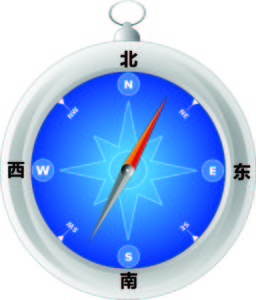
yuē nán běi yuē xī dōng
曰 南 北 曰 西 东
cǐ sì fāng yìng hū zhōng
此 四 方5 应6 乎 中7
Spring, Summer, Autumn and Winter.
The four seasons revolve endlessly.
North, South, East and West,
The four directions are all relative to a center.
注释/Notes
- 曰: call, known as.
- 时: period, time; here it refers to the seasons.
- 运: move, in motion, turn, rotate, revolve.
- 穷: end, stop.
- 方: directions.
- 应: corresponding.
- 中: central, at the heart (of the matter).
大意/General Meaning
The four seasons, Spring, Summer, Autumn, Winter, revolve endlessly, one after the other.
The four directions, measured relative to a center, are North, South, East and West.
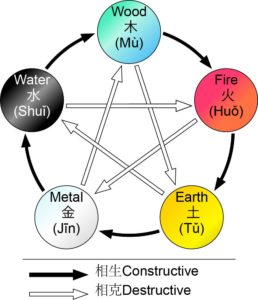
yuē shuǐ huǒ mù jīn tǔ
曰 水 火 木 金 土
cǐ wǔ xíng běn hū shù
此 五 行1 本2 乎 数3
yuē rén yì lǐ zhì xìn
曰 仁4 义5 礼6 智7 信8
cǐ wǔ cháng bù róng wěn
此 五 常9 不 容 紊10
Water, Fire, Wood, Metal and Earth,
These five elements interact with one another and with key numbers.
Benevolence, justice, decorum, knowledge and integrity
These five norms maintain the social order.
注释/Notes
- 五行: the five elements in traditional Chinese astrology and divination.
- 本: foundation, based on.
- 数: divination, astrology, fate and destiny.
- 仁: benevolence, kindness.
- 义: justice.
- 礼: social norms and behavior.
- 智: intellect and talent.
- 信: trust, belief.
- 常: norms, rules, order.
- 紊: messy, chaotic, messed up, disorder.
大意/General Meaning
Ancient Chinese believed that everything in this world are created from the five elements – water, fire, wood, metal and earth. In the Book of Changes (《易经》), the odd numbers 1, 3, 5, 7 and 9 are heavenly numbers () while the even numbers 2, 4, 6, 8, 10 are earthly numbers. The relationships between these ten numbers and the five elements are as follows:
– water is created by heavenly 1 and completed by earthly 6;
– fire is created by earthly 2 and completed by heavenly 7;
– wood is created by heavenly 3 and completed by earthly 8;
– metal is created by earthly 4 and completed by heavenly 9;
– earth is created by heavenly 5 and completed by earthly 10.
The five commons and the three orders (mentioned earlier) (三纲五常) form the basic social order in feudalistic China.
dào liáng shū mài shǔ jì
稻1 粱2 菽3 麦4 黍5 稷6
cǐ liù gǔ rén suǒ shí
此 六 谷7 人 所 食
mǎ niú yáng jī quǎn shǐ
马 牛 羊 鸡 犬8 豕9
cǐ liù chù rén suǒ sì
此 六 畜 人 所 饲10
Rice, millet, beans, wheat, corn and sorghum,
The six main grains that feed the people.
Horses, cows, goats, chickens, dogs and pigs,
These six animals are reared by people.
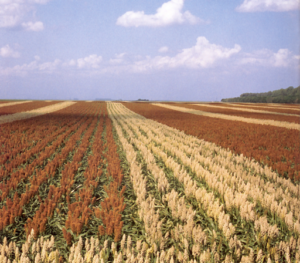
Sorghum Field
注释/Notes
- 稻: rice, rice crops.
- 粱: may refer either to millet or sorghum.
- 菽: legumes, peas and beans.
- 麦: wheat.
- 黍: corn, maize.
- 稷: may refer either to millet or sorghum.
- 谷: general term for cereals and grains.
- 犬: dog.
- 豕: pig.
- 饲: rear.
大意/General Meaning
Rice, millet, beans, wheat, corn and sorghum are the six grains, which are the main source of food for people.
Horses, cows, goats, chickens, dogs and pigs (六畜)are domestic animals that people rear.
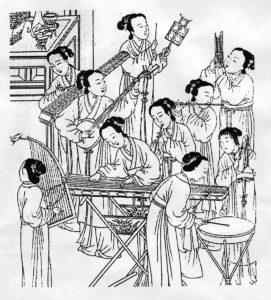
An ancient Chinese dynastic engraving of an all-female ensemble of traditional instrumentalists
yuē xǐ nù yuē āi jù
曰 喜 怒 曰 哀1 惧2
ài wù yù qī qíng jù
爱 恶3 欲4 七 情 具5
páo tǔ gé mù shí jīn
匏6 土7 革8 木 石 金9
sī yǔ zhú nǎi bā yīn
丝10 与 竹11 乃 八 音
Happiness, anger, sadness and fear,
Love, hate and desire, these are the seven passions.
Gourd, clay, leather, wood, stone and metal,
Silk and bamboo- these produce the eight notes we hear.
注释/Notes
- 哀: sadness, sorrow.
- 惧: fear.
- 恶: hatred.
- 欲: desires.
- 具: have, possess.
- 匏: a type of gourd, its skin is used to make instruments.
- 土: clay, earth.
- 革: leather.
- 金: metals.
- 丝: silk, silk threads.
- 竹: bamboo.
大意/General Meaning
Every person, by nature, possess these seven emotions: happiness, anger, sadness, fear, love, hate and desire.
In ancient China, gourd, clay, leather, wood, stone, metal, silk and bamboo were used to make musical instruments. Gourd skin was used to make the base for bowed stringed and wind instruments. Clay was used to make ceramic-based wind instruments. Leather was used for the skin of drums. Wood was used in instruments like clappers. Stone refers to any hard material like jade that originated from rocks and may be used to make percussion instruments. Metal refers to materials like brass which was used to make gongs, cymbals and bells. Silk was used often for strings while bamboo was used to make flutes and other wind instruments.
gāo zēng zǔ fù ér shēn
高 曾 祖 父 而 身
shēn ér zǐ zǐ ér sūn
身 而 子 子 而 孙
zì zǐ sūn zhì xuán zēng
自 子 孙 至 玄 曾
nǎi jiǔ zú rén zhī lún
乃 九 族1 人 之 伦
The forefathers, great-grandfather, grandfather and father
The self, the child and the grandchild.
The great-grandchild and the great-great grandchild,
The nine generations of any family.
注释/Notes
- 九族: Nine generations = Four generations before oneself (father, grandfather, great-grandfather and great-great grandfather) plus four generations after oneself (son, grandson, great-grandson and great-great grandson) plus oneself.
大意/General Meaning
The nine generations were very important to ancient Chinese as they described the familial relationship.
fù zǐ ēn fū fù cóng
父 子 恩 夫 妇 从
xiōng zé yǒu dì zé gōng
兄 则 友 弟 则 恭
zhǎng yòu xù yǒu yǔ péng
长 幼 序1 友 与 朋
jūn zé jìng chén zé zhōng
君 则 敬 臣 则 忠
cǐ shí yì rén suǒ tóng
此 十 义2 人 所 同
Piety between father and son, harmony between husband and wife.
Friendship with the elder siblings and respect from the younger ones.
Seniority among the elders and the young and among friends.
Respect for one’s rulers and loyalty from one’s ministers.
These ten norms apply equally to all.
注释/Notes
- 序: order, here “长幼序” means arrange from the eldest to youngest (eldest first).
- 十义: ten norms, proper decorum, morals, rules. The traditional ten norms as recorded in the Records of Rituals (《礼记》) are: a father’s benevolence (父慈), a son’s piety (子孝), a husband’s good temper (夫和), a wife’s obedience (妻顺), an elder brother’s friendship (兄友), a younger brother’s respect (弟恭), a friend’s trust (朋信), a friend’s loyalty(友义), a leader’s respect (君敬), an officer’s loyalty(臣忠).
大意/General Meaning
Fathers and sons should observe the mutual gratitude among themselves. Relationships between husbands and wives should be harmonious. Elder siblings must love the younger ones just as the younger ones must respect their elder siblings. Proper decorum and order should be observed in the interactions between the elders and the younger generations. There should be trust among friends. If the leader (ruler or king) can respect his subordinates, then his subordinates will be loyal to him. These ten norms in people to people relationships should be observed by everyone.
Image sources
[1] CompassPublic Domain. [2] Five Elements
Source: 5 Elements
http://commons.wikimedia.org/wiki/File%3AWuxing_en.svg
By Benoît Stella alias BenduKiwi (Own work).
CC-BY-SA-3.0 (http://creativecommons.org/licenses/by-sa/3.0/) via Wikimedia Commons. [3] Sorghum field
CC BY 2.5 (http://creativecommons.org/licenses/by/2.5) via Wikimedia Commons.
https://commons.wikimedia.org/wiki/File%3ASorghum_field.png

Separating Wheat from Chaff in Plant Genomes. PLoS Biol 3/1/2005: e39. http://dx.doi.org/10.1371/journal.pbio.0030039 [4] 仕女演乐图 (“Drawing of women of the court performing music”). This was taken from a Ming dynasty edition of Pipa Ji 琵琶記 (The Story of the Lute), Li Zhuowu Ping Ben Pipa Ji 李卓吾評本琵琶記 (Li Zhuowu Criticizes Pipa Ji), dated 1573—1619.