全文/ The Text (5)
Note: You can get a copy of the complete text and translation here.
[This is the second part about ancient China history]táng gāo zǔ qǐ yì shī
唐 高 祖1 起 义 师2
chú suí luàn chuàng guó jī
除 隋 乱 创3 国 基
èr shí chuán sān bǎi zǎi
二 十 传 三 百 载
liáng miè zhī guó nǎi gǎi
梁4 灭 之 国 乃 改
Tang Emperor Gao Zu rose against the ruling family.
Disposed the chaos in Sui, create the foundation for a new country.
Twenty emperors, three hundred years
Until Tang was destroyed by Liang and the country had a new name.
注释/Notes
- 唐高祖: Emperor Gaozu (also known as Li Yuan(李渊)), who established the Tang Dynasty.
- 义师: army who rose to uphold justice.
- 创: established.
- 梁: the Liang Dynasty
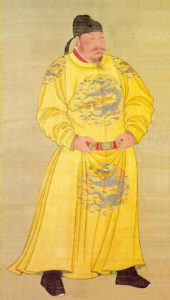
Tang Taizong, 唐太宗
大意/General Meaning
The second and last emperor of Sui was despotic and there were uprisings all over the country. Li Yuan, who occupied the Taiyuan (太原) region, rose the army to attack and occupy Chang’an(长安), then the capital of Sui. In AD 618, with the last emperor of Sui dead, Li Yuan declared himself emperor and founded the Tang dynasty. He was the Emperor Gaozu(高祖) of Tang. His son, Li Shimin (李世民), led the army to gradually eliminate the remaining opposing forces everywhere and in AD626, he ascended the throne and was known as Emperor Taizong(太宗) of Tang. By then he had already completed the task of unifying China.
There are twenty-two emperors (rounded to twenty in the text) in the Tang dynasty and they ruled for a total of 290 years (rounded to three hundred in the text. At the end of the Tang dynasty, the peasant uprising started by Huang Chao (黄巢)was going strong. However, his subordinate, Zhu Wen (朱温), betrayed him and surrendered to the dynasty, changing his name to Zhu Quanzhong (朱全忠) at the same time. In AD907, Zhu Quanzong took the throne and change the dynasty to Liang(梁), he became Emperor Taizu(太祖) of Liang(梁).
liáng táng jìn jí hàn zhōu
梁 唐 晋 及 汉 周
chēng wǔ dài jiē yǒu yóu
称 五 代1 皆 有 由2
yán sòng xīng shòu zhōu chán
炎 宋 兴 受 周 禅3
shí bā chuán nán běi hùn
十 八 传 南 北4 混
liáo yǔ jīn dì hào fēn
辽5 与 金6 帝 号 纷
dài miè liáo sòng yóu cún
迨 灭 辽 宋 犹 存
zhì yuán xīng jīn xù xiē
至 元7 兴 金 绪 歇
yǒu sòng shì yī tóng miè
有 宋 世 一 同 灭
Liang, Tang, Jin, later Han and Zhou,
The five dynasties they were known, each with its own origin and demise.
As the fiery Song rose, the last emperor of Zhou abdicated.
Eighteen emperors in Song amidst the chaos in North and South.
Liao and Jin declared themselves emperors.
When Liao was destroyed, Song still remained.
Then Yuan rose and Jin breathed its last.
Together with Jin, the Song line was destroyed.
注释/Notes
- 五代: The Five Dynasties
- 由: reason.
- 周禅: (forced) abdication by the Later Zhou emperor.
- 南北: Northern Song(北宋) and Southern Song(南宋) Dynasties.
- 辽: the State of Liao.
- 金: the State of Jin.
- 元: the Yuan dynasty started by the Mongol tribe led by Genghis Khan.
大意/General Meaning
After the Tang dynasty, the northern part of China went through five successive dynastic changes, starting with Later Liang(后梁), then Later Tang(后唐), followed by Later Jin(后晋) and Later Han(后汉) and finally Later Zhou(后周). These became known as the “Five Dynasties”. The southern part was however, divided into ten smaller states and became known as the “Ten States(十国)”. There were reasons for the rises and falls of these dynasties and states.
Near the end of the Later Zhou era, Zhao Kuangyin(赵匡胤) took hold of the military command and in AD960, he started the Chen Qiao Revolt (陈桥兵变) and was hailed as the Emperor by his subordinates. He established the Song(宋) Dynasty, what in history today is referred to as Northern Song(北宋) and he became Emperor Taizu(太祖) of Song after having forced the eight-year-old last emperor of Later Zhou 周恭帝to abdicate. According to an ancient traditional analysis of the five elements, Northern Song was classified as Huo De Wang (火德王, literally King with Fiery Virtue) and hence Northern Song was also known as Yan Song (炎宋).
Towards the end of the Northern Song period, the State of Jin(金) grew strong and in AD1127, the Jin army attacked the capital city Bianjing (汴京known as Kaifeng(开封) today) and took the Song emperor hostage. Northern Song was destroyed and the Duke of Kang(康王), Zhao Gou(赵构) escaped to Jiangnan(江南) and in Linan(临安) declared himself emperor to continue the Song rule. This became the Southern Song(南宋) described in historical texts.
In all, eighteen emperors ruled both the Northern and Southern Song periods. It would be until the Yuan Dynasty until China was unified again.
Near the end of Southern Song era, two tribes were dominant in the northern part. One was the State of Liao, founded by the Qidan (契丹)tribe in the AD916 ruled by the Yelu(耶律) family, it lasted for 303 years until Western Liao was destroyed in AD1218. The State of Jin, founded by the Nuzheng(女真) tribe which eventually came to rule most of China near the end of the Song dynasty.
When Liao was destroyed, Southern Song still existed for a period but not for long.
Near the end of the 12th century, the Mongol (蒙古)tribe started to rise to power in northern China. In 1206, Temujin established the Mongol State and called himself Genghis Khan(成吉思汗). In AD 1234, the Mongols annihilated the State of Jin. From AD1114 until it ended, the Jin dynasty lasted 120 years. In AD1260, Genghis Khan’s grandson, Kublai Khan, became the Khan and in the year AD1264, he shifted the capital to what is known as Beijing today (then it was known as Da Du(大都)) and established the Yuan Dynasty.
In AD1279, the Song line ended and China was unified again.
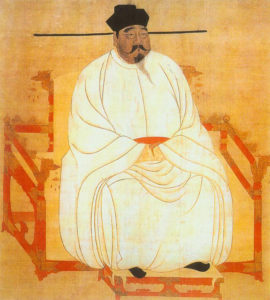
宋太祖,Song Taizu
lì zhōng guó jiān róng dí
莅1 中 国 兼 戎2 狄3
jiǔ shí nián guó zuò fèi
九 十 年 国 祚4 废
míng tài zǔ jiǔ qīn shī
明 太 祖5 久 亲 师6
chuán jiàn wén fāng sì sì
传 建 文7 方 四 祀8
qiān běi jīng yǒng lè sì
迁 北 京 永 乐9 嗣10
dài chóng zhēn méi shān shì
迨11 崇 祯12 煤 山13 逝
The minority tribes arrived in China.
For ninety years, their rule endured till it was overthrown.
Emperor Taizu led the army for years to build the Ming era.
Emperor Jianwen received the throne but ruled for only four years.
Then the capital was shifted to Beijing in the reign of Yongle.
Until the last Ming emperor, Chongzhen, died in Mt Mei.
注释/Notes
- 莅: arrived.
- 戎: ancient Chinese collective reference to minority tribes from western parts of China.
- 狄: ancient Chinese collective reference to minority tribes from northern parts of China.
- 祚: the throne.
- 明太祖: Emperor Taizu who founded the Ming Dynasty. Also known by the name Zhu Yuanzhang(朱元璋).
- 亲师: led the army himself.
- 建文: Emperor Jianwen, second emperor in the Ming Dynasty, grandson of Emperor Taizu. Also known by the name Zhu Yunwen(朱允炆).
- 祀: years
- 永乐: a period in the Ming Dynasty ruled by Emperor Chengzu(明成祖).
- 嗣: inherited.
- 迨: until.
- 崇祯: last emperor of Ming dynasty who committed suicide.
- 煤山: today known as Jing Shan(景山).
大意/General Meaning
The Mongols entered China and conquered the various tribes along the borders. They built a unified country and ruled for ninety years until the Yuan government was overthrown.
Anti-government uprisings at the end of the Yuan dynasty erupted everywhere in the country. Zhu Yuanzhang led and commandeered an army for a long period through several battles before he destroyed various seceded fragments to found the Ming Dynasty. He became known as the Emperor Taizu of Ming (明太祖). When he died, he passed the throne to his grandson, Zhu Yunwen who became known as Emperor Jianwen.
Emperor Jianwen was on the throne for only four years when his uncle, the Duke of Yan (燕王, fourth son of Emperor Taizu), Zhu Di(朱棣), led a revolt and seized the throne to become the third emperor of Ming (Emperor Chengzu). Emperor Chengzu began the reign of Yongle where the capital was shifted back to Beijing from Nanjing.
During the reign of the last Ming emperor, Chongzhen, the peasant uprising exploded across the country and the army led by Li Zicheng (李自成) took over Beijing. Emperor Chongzhen fled to Mt Mei (煤山) and killed himself, ending the Ming dynasty.
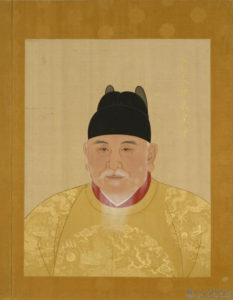
明太祖画像, A portrait of the first emperor of the Ming dynasty.
niàn èr shǐ quán zài zī
廿1 二 史 全 在 兹2
zǎi zhì luàn zhī xīng shuāi
载3 治4 乱5 知 兴6 衰7
Twenty-two dynasties, all described here.
Prosperous rules and chaos were all recorded so that one may know the rise and fall of rulers.
注释/Notes
- 廿: twenty.
- 兹: here (literally mean recorded in these texts).
- 载: record.
- 治: how a country/state was governed.
- 乱: chaos and disorders, wars.
- 兴: prosperity.
- 衰: decline.
大意/General Meaning
This version of the “Three Characters Classic” was based on a popular edition published during the Qing Dynasty which succeeded the Ming dynasty. There were twenty-two dynasties up to the Qing Dynasty then. All the historical texts until then recorded the details of the various periods of good governance and prosperity as well as the periods of chaos and wars, so that the readers would be able to understand why dynasties rose and fell and hopefully learned from these lessons.
dú shǐ zhě kǎo shí lù
读 史 者 考 实 录1
tōng gǔ jīn ruò qīn mù
通2 古 今 若 亲 目
kǒu ér sòng xīn ér wéi
口 而 诵3 心 而 惟4
zhāo yú sī xī yú sī
朝 于 斯5 夕 于 斯
A history student must check actual records.
Understand the past and the present, as if one was there.
Recite loudly, put your heart into the events.
Repeat during the days, repeat at nights.
注释/Notes
- 实录: actual records.
- 通: thorough understanding.
- 诵: recite loudly.
- 惟: consider, ponder, mull over.
- 斯: this.
大意/General Meaning
Other than studying the historical texts, it is also important to check the historical records such as the “Actual Records of Ming”(《明实录》) and the “Actual Records of Qing”(《清实录》). When one has thoroughly understood the facts, it would be as if you have witnessed the actual events unfolding.
In studying these texts, it is important to not just recite these texts but also to spend some efforts to think over what you have read and to understand its significance. A diligent student will study days and nights without stopping until he/she has assimilated the materials.
Image Sources
[1] 唐太宗, Tang Taizong[Public Domain] Hanging scroll, color on silk. Size 271 x 126.8 cm (height x width). Located in National Palace Museum, Taipei. [2] 宋太祖, Song Taizu
[Public Domain] The painting is among those recorded in Wang Yun’s (王恽) “Catalog of Painting and Calligraphy” (书画目录) written during the Yuan dynasty.
(故宮圖像選萃 (Gu gong tu xiang xuan cui) Masterpieces of Chinese Portrait Painting in the National Palace Museum. Taipei: National Palace Museum. 1971.) [3] 明太祖画像, A portrait of the first emperor of the Ming dynasty.
By 明朝画师 (国立故宫博物院, National Palace Museum)
Public domain via Wikimedia Commons.