全文/ The Text (4)
Note: You can get a copy of the complete text and translation here.
[This section is about ancient China history]jīng zǐ tōng dú zhū shǐ
经1 子2 通3 读 诸 史4
kǎo shì xì zhī zhōng shǐ
考 世 系5 知 终 始
After one has mastered the classics and the philosophies, one should study history.
Understand the line of emperors, the rise and fall of dynasties.
注释/Notes
- 经: classics.
- 子: books by the various ancient Chinese philosophers.
- 通: understood.
- 史: history books
- 世系: family trees and relations. This refers to understanding the family line in the different Chinese dynasties.
大意/General Meaning
After the learner has mastered the classics and understood the main philosophies, he/she should move on to study history.
In history, the learner should try to understand the line of the emperors and how the various dynasties rose and fell in order to assimilate important lessons.
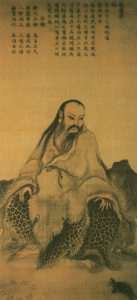
伏羲坐像, A seated portrait of Fuxi
zì xī nóng zhì huáng dì
自 羲1 农2 至 黄 帝3
hào sān huáng jū shàng shì
号 三 皇 居 上 世
táng yǒu yú hào èr dì
唐4 有 虞5 号 二 帝
xiāng yī xùn chēng shèng shì
相 揖 逊6 称 盛 世
Fuxi, Shennong and Huangdi,
The three sovereigns who built the ancient world.
Yao and Shun were the two ancient emperors.
They abdicated in favor of the next able king in an age of prosperity.
注释/Notes
- 羲: ancient emperor Fuxi, 伏羲(伏羲太昊氏).
- 农: ancient emperor Shennong, 神农(炎帝神农氏), who ruled after Fuxi.
- 黄帝: ancient emperor (黄帝轩辕氏), who ruled after Shennong.
- 唐: Tang Yao, 唐尧, who ruled after Huang Di.
- 虞: Yu Shun, 虞舜, who ruled after Tang Yao.
- 逊: gave up one’s place to another, abdicated.
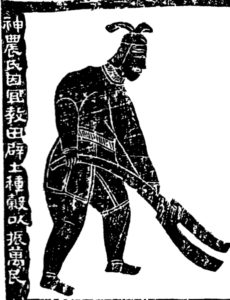
神农, Shennong
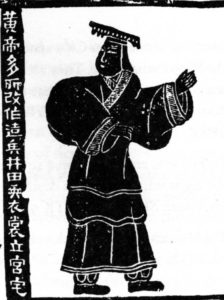
黄帝, Huangdi (Yellow Emperor)
大意/General Meaning
Fu Xi, Shen Nong and Huang Di refer to the three sovereigns of ancient China.
Tang Yao and Yu Shun were known as the two emperors in ancient China. Tang Yao abdicated in favor of Yu Shun instead of his son as he felt Yu Shun was a more able successor. Similarly, Yu Shun abdicated in favor of Xia Yu, whom he felt was the best person to lead the country. When Tang Yao and Yu Shun were emperors, they created a period of peace and prosperity in the ancient world.
xià yǒu yǔ shāng yǒu tāng
夏 有 禹1 商 有 汤2
zhōu wén wǔ chēng sān wáng
周 文 武3 称 三 王
Yu of Xia, Tang of Shang, Wen and Wu of Zhou
They were known as the three Kings.
注释/Notes
- 禹: Xia Yu(夏禹 or simply禹) who founded the Xia(夏) Dynasty.
- 汤: Tang(汤) who founded the Shang (商) Dynasty.
- 周文武: King Wen of Zhou, Zhou Wenwang(周文王) and King Wu of Zhou, Zhou Wuwang(周武王) of the Zhou (周) Dynasty.
大意/General Meaning
After Yu Shun, Xia Yu became the emperor. He founded the Xia Dynasty and began a system when the next in line to the throne would be from the ruling family instead of an able outsider. The Xia Dynasty was overthrown by Tang who then founded the Shang Dynasty. Then father and son, the dukes of Zhou (later kings of Zhou, King Wen and King Wu) worked to overthrow the Shang Dynasty. When King Wu (the son) succeeded in eliminating the last emperor of the Shang Dynasty, he founded the Zhou Dynasty.
Together, Xia Yu, Tang and the two Kings of Zhou were known as the “Three Kings”.
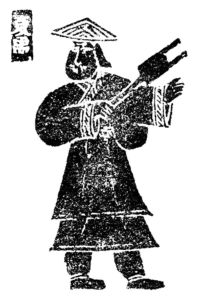
大禹治水,
Xia Yu and Flood Control
xià chuán zǐ jiā tiān xià
夏 传 子 家 天 下1
sì bǎi zǎi qiān xià shè
四 百 载2 迁 夏 社3
tāng fá xià guó hào shāng
汤 伐 夏4 国 号 商
liù bǎi zǎi zhì zhòu wáng
六 百 载 至 纣5 亡
Xia kings were succeeded by sons, the family now ruled the country
Four hundred years before the Xia society shifted.
Tang destroyed Xia and established the Shang Dynasty.
Six hundred years and Shang ended when King Zhou died.
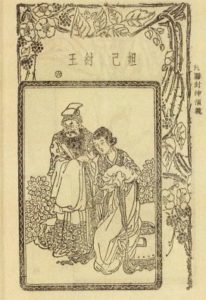
The story of the last king of Shang and the battle of wits and force between him and the Dukes of Zhou were immortalized in a famous classic work, Investiture of the Gods (封神演义). This is an extract of an image from the original book that shows King Zhou and his concubine.
注释/Notes
- 家天下: the family rules the country. Unlike his predecessors who abdicated in favor of the next person they thought was suitable to rule the country, the emperors of Xia passed the throne to their sons and grandsons.
- 载: years.
- 社: society-at-large, another term for country or state.
- 汤伐夏: Shang Tang, 商汤, led an uprising to topple the Xia Dynasty and established the Shang Dynasty.
- 纣: last emperor of the Shang Dynasty.
大意/General Meaning
After Yu Shun, Xia Yu became the emperor. He founded the Xia Dynasty and handed the throne over to his son, Qi(启), thus starting a system where the next in line to the throne would be from the ruling family instead of an able outsider. Thus, the family controlled the country. The Xia Dynasty would last four hundred years before the people became unhappy at the despotic rule of the last ruler, Jie (夏桀), and supported the uprising started by Tang.
Tang overthrew the last ruler in the Xia Dynasty and founded the Shang Dynasty (sometimes known as Yin Shang, 殷商). The Shang Dynasty lasted six hundred years before the last ruler, Zhou (殷纣), was killed for his despotic and barbaric rule and the Shang Dynasty ended.
zhōu wǔ wáng shǐ zhū zhòu
周 武 王 始 诛1 纣
bā bǎi zǎi zuì cháng jiǔ
八 百 载 最 长 久
zhōu zhé dōng wáng gāng zhuì
周 辙2 东 王 纲3 坠4
chěng gān gē shàng yóu shuì
逞5 干 戈6 尚 游 说7
King Wu of Zhou eliminated King Zhou of Shang.
A dynasty was built that lasted eight hundred years, the longest ever.
When the Zhou dynasty shifted eastwards, the royal order collapsed.
People flaunted spears and shields as lobbyists gained popularity.
注释/Notes
- 诛: annihilated, destroyed.
- 辙: moved, shifted.
- 王纲: royal rule, royal structure.
- 坠: weakened, fallen.
- 逞: demonstrated, displayed.
- 干戈: weapons, armament.
- 游说: political lobbying.
大意/General Meaning
The State of Zhou was under Shang’s rule during the last few years of the Shang Dynasty. This state was managed by Duke of Zhou who started the campaign to end Zhou’s despotic rule. His son, King Wu of Zhou, succeeded in staging an uprising to overthrow the Shang Dynasty. When he realized he was defeated, the last ruler of Shang, King Zhou, set himself on fire. King Wu founded the Zhou Dynasty that lasted for eight hundred years, the longest for any dynasty in China’s ancient history.
When it came to King Ping of Zhou (周平王), he moved the capital eastwards to Luoyang(洛阳) and started a period in history known as the Eastern Zhou(东周) era. From then on, the central grip of the royal throne started to weaken and the various dukes in the different states started to get stronger and began wars to fight for territories and power with one another. At the same time, lobbyists also began to go around the different states to promote their political ideas or to offer their strategies.
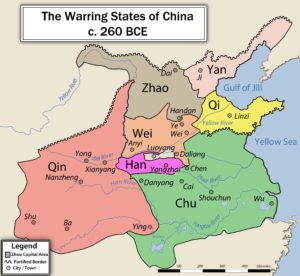
The seven warring states (one color for each state) before Qin annexed the other 6 states to rule supreme. The seven states are Qin(秦), Han(韩), Chu(楚), Wei(魏), Qi(齐), Yan(燕), and Zhao(赵).
shǐ chūn qiū zhōng zhàn guó
始 春 秋 终 战 国
wǔ bà qiáng qī xióng chū
五 霸1 强 七 雄2 出
yíng qín shì shǐ jiān bìng
嬴 秦 氏3 始 兼 并
chuán èr shì chǔ hàn zhēng
传 二 世4 楚5 汉6 争
The Spring and Autumn era began, followed by the Warring States.
The Five Overlords reigned and seven states emerged.
The Ying family of Qin rose and began to unify the warring states.
A unity that ended with contention by Chu and Han in the next generation.
注释/Notes
- 五霸: the five Overlords in the Spring and Autumn era (春秋五霸).
- 七雄: the seven warring states: Qi(齐), Chu(楚), Yan(燕), Zhao(赵), Han(汉), Wei(魏) and Qin(秦).
- 嬴秦氏: also known as Qin Shihuang(秦始皇). He was the ruler of the State of Qin(秦) before he conquered all other states and unified China. His other name is Ying Zheng(嬴政), where Ying is the family name.
- 二世: Qin Shihuang’s son, Hu Hai(胡亥).
- 楚: the State of Chu(楚), led by Overlord of Western Chu (Xi Chu Bawang, 西楚霸王), Xiang Yu(项羽).
- 汉: the State of Han汉, led by Han Gaozu(汉高祖), Liu Bang(刘邦).
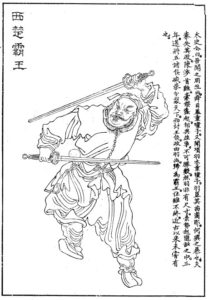
项羽 (西楚霸王), Xiang Yu, the Overlord of Chu, (232 BC – 202 BC) eventually lost to Liu Bang of Han. His exploits and life inspired many famous stories of which “Farewell to my concubine” (《霸王别姬》), which described the story between him and his lover, became a very famous opera.
大意/General Meaning
The beginning of the Eastern Zhou era is known as the Spring and Autumn period (BC 771 to approximately BC 475) and the later part is known as the Warring States era (approximately BC 475 to BC 221). The five Overlords in the Spring and Autumn period ruled in succession, starting with Qi Huangong(齐桓公), Jin Wengong(晋文公), Qin Mugong(秦穆公), Song Xianggong(宋襄公), and finally Chu Zhuangwang(楚庄王). In the Warring States period, there were seven states controlling the whole of China.
In BC 246, the Duke of Qin, Ying Zheng, started a war to unify the other six states and succeeded in BC 221. When he died, his son ascended to the throne but by this time, there was strong anti-Qin sentiments and uprisings were happening everywhere. From these various battles, two major powers eventually emerged, that of Chu led by Xiang Yu and Han led by Liu Bang. Both powers began their intense fight for supremacy.
gāo zǔ xīng hàn yè jiàn
高 祖 兴 汉 业 建
zhì xiào píng wáng mǎng cuàn
至 孝 平1 王 莽2 篡3
guāng wǔ xīng wéi dōng hàn
光 武4 兴 为 东 汉
sì bǎi nián zhōng yú xiàn
四 百 年 终 于 献5
Han Emperor Gaozu established the Han dynasty
Lasted till Emperor Ping when Wang Mang usurped the throne.
Emperor Guang Wu rose to build the Eastern Han Dynasty.
Four hundred years before it ended with Emperor Xian.
注释/Notes
- 孝平: Emperor Xiaoping of Han Dynasty, also known as Han Pingdi(汉平帝).
- 王莽: an usurper who deposed of Emperor Xiaoping and declared himself emperor.
- 篡: usurped, seized the throne.
- 光武: Emperor Guangwu, also known as Liu Xiu(刘秀), who defeated Wang Mang and regained the throne, re-established the Han dynasty as Eastern Han.
- 献: Emperor Xian (Han Xiandi, 汉献帝), the last emperor of the Eastern Han Dynasty.
大意/General Meaning
Liu Bang eliminated Xiang Yu (Overlord of Chu) and built the Han Dynasty in what was also referred to as the Western Han(西汉) era. He was known as Emperor Gaozu (高祖) of Han. It lasted about two hundred years until Emperor Ping near the end of the Western Han period when Wang Mang, a usurper killed the emperor, seized the throne and declared himself emperor of the new dynasty.
Liu Xiu, staged an uprising to overthrow Wang Mang and seized the throne back for the Liu family. He rebuilt the Han Dynasty and this period became known as the “Eastern Han(东汉)” era. Liu Xiu was called Emperor Guang Wu of Han. The western and eastern Han periods together lasted 411 years (400 was a round number) until Emperor Xian.
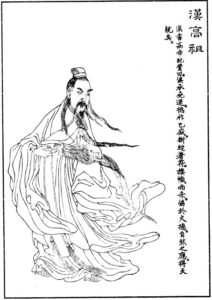
刘邦 (汉高祖), Liu Bang (Emperor Gaozu of Han) was the first commoner in ancient China who was crowned Emperor.
wèi shǔ wú zhēng hàn dǐng
魏1 蜀2 吴3 争 汉 鼎4
hào sān guó qì liǎng jìn
号 三 国 迄5 两 晋6
sòng qí jì liáng chén chéng
宋 齐 继 梁 陈 承
wéi nán cháo dū jīn líng
为 南 朝7 都 金 陵8
Wei, Shu and Wu started a three-way battle for the Han throne.
They were the “three kingdoms” that ended with the two Jin dynasties.
Then came the Song and Qi, followed by the Liang and Chen.
Together they formed the Southern Dynasty with the capital at Jinling.
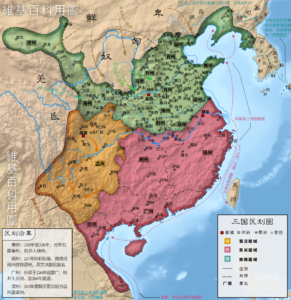
The administration regions of the Three Kingdoms in 262: Shu (yellow), Wei (green), Wu (magenta) 三国行政区划
注释/Notes
- 魏: the State of Wei, led by Cao Cao(曹操).
- 蜀: the State of Shu, led by Liu Bei(刘备).
- 吴: the State of Wu, led by Sun Quan(孙权).
- 鼎: an ancient cauldron used to symbolize the emperor’s rule. Also, a symbol of the throne.
- 迄: until.
- 两晋: Eastern Jin and Western Jin Dynasties.
- 南朝: the Southern Period (after Jin) which comprised of the four successive smaller dynasties, starting from Song(宋), Qi(齐), Liang(梁) and finally Chen(陈).
- 金陵: this place is known as Nanjing today.
大意/General Meaning
At the end of the Eastern Han, military rulers gained power and eventually, three powers emerged: Wei led by Cao Cao, Shu led by Liu Bei and Wu led by Sun Quan. They each coveted the Han throne. This period became known as the “three Kingdoms” (which the famous novel, ” Romance of the Three Kingdoms” is based on). In the last few years of Wei, another military commander, Sima Si(司马氏), took power and established the Jin(晋) dynasty. He also destroyed the states of Shu and Wu, thus reuniting China again and built the capital at Luoyang. The Western Jin(西晋) era then began. In AD316, Western Jin fell and the ruling family escaped to Jiangnan(江南) where they built the Eastern Jin dynasty with the capital at Jiankang (健康, which is Nanjing (南京) today).
After the Eastern Jin(东晋) period, in the southern part of China, five successive dynasties were formed one after another, staring with Song, followed by Qi, then Liang and finally Chen. This period was collectively known as the Southern Dynasty with the capital at Jinling (Nanjing today).
běi yuán wèi fēn dōng xī
北 元 魏1 分 东 西
yǔ wén zhōu yǔ gāo qí
宇 文 周2 与 高 齐3
dài zhì suí yī tǔ yǔ
迨4 至 隋 一 土 宇5
bù zài chuán shī tǒng xù
不 再 传6 失 统 绪7
In the north, there was Wei which split into East and West.
Both Weis were then replaced by the Northern Zhou and Qi.
Until the Sui dynasty, were the lands united again.
But with only one succession, the dynasty was soon gone.
注释/Notes
- 北元魏: Northern Wei was ruled by the Xianbei(鲜卑) tribe.
- 宇文周: Emperor Min (闵) (also known as Yu Wenjue宇文觉) of Northern Zhou(北周).
- 高齐: Emperor Wenxuan(文宣)(also known as Gao Yang高洋) of Northern Qi(北齐).
- 迨: until.
- 一土宇: all the states unified under one rule.
- 不再传: lasted only one generation.
- 失统绪: lost the throne.
大意/General Meaning
After the Western Jin era, sixteen small dynasties emerged one after another in the northern part of China. This period was thus called the “sixteen states era”. The noble family, Tuoba(拓跋), from the Xianbei tribe built the Northern Wei (北魏)state which soon became powerful and gradually they united Northern China. When Emperor Xiaowen (孝文) ruled the state, he adopted the policies of the Han dynasty and change his family name to Yuan(元), so Northern Wei was also known as Yuan Wei(元魏). Subsequently there was an internal uprising and Wei was split into Eastern and Western Wei. The Gao(高) family which took control of Eastern Wei renamed it to Qi and the state became known in history as Northern Qi(北齐) while the Yuwen(宇文) family took hold of Eastern Wei and renamed it Zhou and the state became known as Northern Zhou(北周).
At the end of the Northern Zhou period, Yang Jian(杨坚) rose to take over control of the throne. In AD581, he declared himself emperor and established the Sui(隋) Dynasty and became known as Sui Wendi(隋文帝). In AD589, he destroyed the Chen(陈) dynasty in the southern part and unified China once again. The Sui dynasty only lasted until the second emperor, Sui Yangdi(隋炀帝).
Image sources
[1] 伏羲坐像, A seated portrait depicting Fuxi.By 马麟, Ma Lin, Song Dynasty.
Ink and color on silk; hanging scroll, 249.8 x 112 cm.
National Palace Museum, Taipei, Taiwan. [2] 神农, Shennong
Mural painting from Han dynasty [Public domain], via Wikimedia Commons. [3] 黄帝, Huangdi (Yellow Emperor)
Mural painting from Han dynasty [Public domain], via Wikimedia Commons. [4] 大禹治水, Xia Yu and Flood Control
Mural painting from Han dynasty [Public domain], via Wikimedia Commons. [5] 《封神演义》插图, Extract from the Investiture of Gods
By Xu Zhong Lin, 许仲琳, Ming Dynasty
Public Domain [6] 战国七雄地图, China Map 260BCE Warring States Period
By Philg88 (Own work) [CC BY-SA 3.0 (http://creativecommons.org/licenses/by-sa/3.0) or GFDL (http://www.gnu.org/copyleft/fdl.html)], via Wikimedia Commons.
(https://commons.wikimedia.org/wiki/File%3AEN-WarringStatesAll260BCE.jpg) [7] 项羽 (西楚霸王), Xiang Yu (232 BC – 202 BC)

By ShangGuan Zhou(上官周) [Public domain], via Wikimedia Commons [8] 刘邦 (汉高祖), Liu Bang (Emperor Gaozu of Han)
By ShangGuan Zhou(上官周) [Public domain], via Wikimedia Commons. [9] 三国行政区划(繁), The Administration of the Three Kingdoms in 262.
By 玖巧仔 [CC BY-SA 3.0 (http://creativecommons.org/licenses/by-sa/3.0)], via Wikimedia Commons.