全文/ The Text
Note: You can get a copy of the complete text and translation here.
rén zhī chū xìng běn shàn
人 之 初1 性2 本 善3
xìng xiāng jìn xí xiāng yuǎn
性 相 近 习4 相 远
gǒu bù jiào xìng nǎi qiān
苟5 不 教6 性 乃7 迁8
jiào zhī dào guì yǐ zhuān
教 之 道9 贵10 以 专11
All persons when they begin, their natures are basically good.
While the natures are similar, the habits create differences.
If indulged and not taught, a person’s character deviates.
And for the best teaching method, its value lies in focus.
注释/Notes
- 初: the beginning of life, a newborn.
- 性: character, temperament, one’s nature.
- 善: good, kind, benevolent.
- 习: habits, behavior.
- 苟: if.
- 教: teach.
- 乃: will then.
- 迁: change, deviate.
- 教之道: method of teaching.
- 专: focus.
- 贵: value.
大意/General Meaning
Every person born to this world is basically kind and newborns are all similar in nature. What causes us to be different is the environment and circumstances we grow up in, where we each begins to form different habits and beliefs, develop the good and bad sides of our characters and deviates from our basically good nature. This is what differentiate us.
A child cannot be indulged and should have a strict upbringing, so that his basically good nature will not deviate and turn bad. The best way to teach a child is to be focused, i.e. guide the child through various stages (and not jump from one topic to another). The classic suggested that a child should first learn basic manners, then basic knowledge, basic texts before he/she move on to the four books, six classics, the philosophies and finally history.
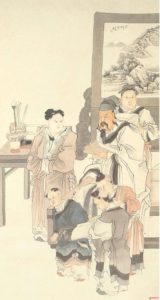
Dou Yan San and his sons《窦燕山教子图》
xī mèng mǔ zé lín chù
昔1 孟 母 择 邻 处
zǐ bù xué duàn jī zhù
子2 不 学 断 机 杼3
dòu yàn shān yǒu yì fāng
窦 燕 山4 有 义 方5
jiào wǔ zǐ míng jù yáng
教 五 子 名 俱 扬6
Mencius’ mother in olden days chose his environment.
When the child would not learn, she ripped the cloth on her loom.
Dou Yanshan had the right method.
He taught five sons, all rose to prominence.
注释/Notes
- 昔: in the past, long ago.
- 子: refer to Mencius, a famous ancient Chinese philosopher.
- 机杼: loom, a device used to weave cloths in ancient China.
- 窦燕山: Dou Yujun (窦禹钧), a historical person who lived during the “Five Dynasties Era”. Where he lived, the place was known as “燕山” (Yanshan), hence he was also known as Dou Yanshan.
- 义方: good method.
- 扬: became famous or well-known.
大意/General Meaning
During the warring states period, Mencius’ mother shifted three times until they settled near a school so that Mencius would have a conducive environment to study in. Once Mencius skipped school and ran home. Heartbroken, his mother took a knife and ripped from the loom the cloth she was painstakingly weaving, saying to Mencius that if he forsakes his studies, he would be like this broken cloth, useless. On hearing this, it was said Mencius resolved to study hard to become a great person.
Dou, who lived during the Five Dynasties period in the state of Jin(晋) used the correct method to raise his five sons(窦仪、窦俨、窦侃、、窦偁、窦僖) and all became well-known officials during the Song dynasty.
yǎng bù jiào fǔ zhī guò
养1 不 教2 父 之 过3
jiào bù yán shī zhī duò
教 不 严4 师 之 惰5
zǐ bù xué fēi suǒ yí
子6 不 学7 非8 所 宜9
yòu bù xué lǎo hé wéi
幼10 不 学 老 何 为11
Raises but fails to guide is a bad father.
Teaches but fails to discipline reflects a lazy teacher.
A child should learn, not doing so is not desirable.
If one fails to learn when young, what can one do in old age?
注释/Notes
- 养: raise, bring up.
- 不教: fails to teach.
- 过: fault, mistake.
- 严: strict.
- 惰: laziness, fail in one’s duty.
- 子: child.
- 不学: fails to learn.
- 宜: should.
- 幼: when one is still young.
- 何为: what to do.
大意/General Meaning
Having brought the child (children) to this world, a father should do more than just raise the child(children), he should also educate and guide them. Otherwise, he would have failed in his duty as the father. Similarly, a teacher would have failed in his/her duty if he/she only teaches but continues to be lax with the child on his learning and fails to be strict that the child should learn properly.
We are born to this world to learn and we should learn. If the child will not start his/her learning now (to acquire skills and knowledge), what can the child do when he/she is older?
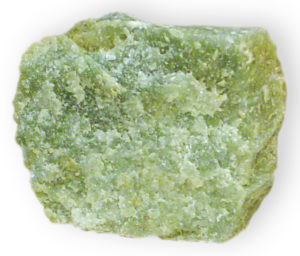
Raw Jade 玉石
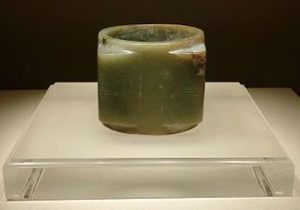
Jade Vessel 玉器
yù bù zhuó bù chéng qì
玉 不 琢1 不 成 器2
rén bù xué bù zhī yì
人 不 学 不 知 义3
wéi rén zǐ fāng shǎo shí
为 人 子4 方 少 时5
qīn shī yǒu xí lǐ yí
亲6 师 友7 习8 礼 仪9
A piece of raw jade cannot be a useful vessel.
The ignorant would not know what is right.
A child, while still young,
Should observe his family and friends to learn manners and proprietary.
注释/Notes
- 琢: carve, mold.
- 器: something that is useful.
- 义: morals, values.
- 为人子: as someone’s son or daughter.
- 少时: when one is young.
- 亲: close relations, respect.
- 师友: good teachers and good friends.
- 习: learn.
- 礼仪: rituals, rites, socially accepted behavior, manners.
大意/General Meaning
A piece of jade, not carved, is just a stone and cannot be used for any purposes (in the past, jade was used for cups, plates, containers), hence it is not useful. Similarly, a person who will not learn will not know what is right or understand the order of things and hence will not be able to contribute meaningfully to the society.
Every one of us is born as someone’s child. When one is still young, it is important to start your learning and the best way to start is to observe the people closest to you to learn the social norms and manners.
xiāng jiǔ líng néng wēn xí
香1 九 龄2 能 温 席3
xiào yú qīn suǒ dāng zhí
孝 于 亲 所 当 执4
róng sì suì néng ràng lí
融5 四 岁 能 让 梨6
tì yú zhǎng yí xiān zhī
悌7 于 长8 宜 先 知9
At nine years old, Huang Xiang warmed his father’s bed.
Filial piety is a duty that should be expressed with actual actions.
At four years old, Kong Rong gave the larger pears to his brothers.
The younger ones should be taught early to respect and give in to their elders.
注释/Notes
- 香: Huang Xiang (黄香), a Jiangxia (Hubei today) native who lived during the Eastern Han(东汉) period. Well-known for his piety. Also well-versed in classics and was a court official.
- 九龄: nine years old.
- 温席: warmed the bed.
- 执: what one should do.
- 融: Kong Rong (孔融), a famous scholar who lived in the State of Lu(鲁) during the Eastern Han period.
- 让梨: gave up a pear.
- 悌: love and respect that a younger sibling has for an older sibling.
- 长: older siblings, elder brothers and/or sisters.
- 知: understood, knew.
大意/General Meaning
This is a story from the Eastern Han dynasty. Huang Xiang, who lost his mother when he was nine years old, tried his best to be filial to his father. When it was summer, he would fan the bed to make it cool for his father and if it was winter, he would use his body to warm his father’s bed so that his father could sleep better. The gist of the story is that it is every child’s duty to be filial to his/her parents.
Another story from Eastern Han. When he was four years old, Kong Rong’s family received some guests who brought pears for the children in his family. Kong Rong picked the smallest pear so that his siblings could have the larger pears. This is often cited to highlight the idea that the younger siblings should respect and give in to their elder siblings.
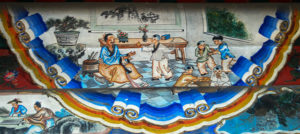
A wall mural in the summer palace depicting the story of Kong Rong sharing the pears with his brothers,
颐和园长廊彩绘:孔融让梨
shǒu xiào tì cì jiàn wén
首 孝1 悌2 次 见3 闻4
zhī mǒu shù shí mǒu wén
知 某 数5 识 某 文6
yī ér shí ér bǎi
一 而7 十 十 而 百
bǎi ér qiān qiān ér wàn
百 而 千 千 而 万
Foremost is filial piety and fraternal love, then sights and sounds.
Know the numbers and understand the texts.
From one to ten, tens to a hundred,
Hundreds to a thousand, thousands to ten thousand.
注释/Notes
- 孝: filial to one’s parents.
- 悌: respect one’s elder siblings.
- 见: what the eyes can see.
- 闻: what the ears can hear.
- 数: numbers, mathematics.
- 文: text, written words, literature.
- 而: until, up to.
大意/General Meaning
The most important thing that a child should first learn is to be filial to his/her parents and to love and respect his/her siblings. After this, the child should start to gain other knowledge and information. Of these, the child should learn mathematics as well as learn how to read.
When the child starts to study mathematics, he/she should be first taught to count from one to ten, then from ten to a hundred, then from a hundred to a thousand and from thousands to tens of thousands and so on.
Image sources:
[1] 《窦燕山教子图》, Dou Yanshan and his sonsArtist/画家 – Ren Xun (Qing Dynasty), 任薰 (清)
Source: http://www.artworld.cn/a/Collection/cnart/qi/2011/0110/5651.html
Ink and color on paper. Collection of Suzhou Museum.
纸本设色,苏州博物馆藏。 [2] Jadeite (raw jade)
Title: Jadeite Sodium aluminum silicate Burma 3025.jpg
By Dave Dyet (own work)
Public domain via Wikimedia Commons (http://www.shutterstone.com, http://www.dyet.com). [3] 三星堆玉琮, An example of a jade vessel
By Tyg728 (Own work)
[CC BY-SA 4.0 (http://creativecommons.org/licenses/by-sa/4.0)], via Wikimedia Commons.