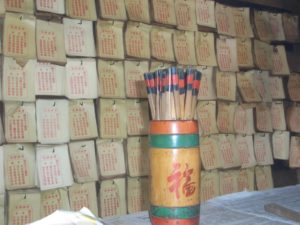
Fortune sticks used in Chinese temples to seek divine advice.
In Asia, sortilege – which is divination by drawing lots, usually a set of fortune sticks – was and still is very popular. Each set of fortune sticks is often associated with a particular deified personality such as Guan Yu (also known as Guan Di) who lived during the Three Kingdoms period in ancient China, mythical personalities as well as gods and goddesses. While older divination methods like I-Ching were used by emperors and ministers alike to determine the probable outcomes of important decisions like battles and succession, sortilege was and still is mainly used by commoners and temple devotees on events and decisions that affect everyday life like marriage, career, health and family.
Sortilege in Asia is usually performed in a temple, although there are now numerous online and mobile applications that reproduced the form of an actual sortilege. In the Asian temples, the devotees will usually make an offering to the gods by burning incense before they take a cylindrical tube, usually made of bamboo, that may contain anything from 60 up to 100 sticks with a different number written on each depending on the deity involved. For example, the Oracle for the Buddha Guan Yin has either 100 or 130 lots, with the latter practically not in use today. The devotee will shake the cylinder until a Lot falls out. The message from heavens will then be the one related to that particular number printed on the Lot.